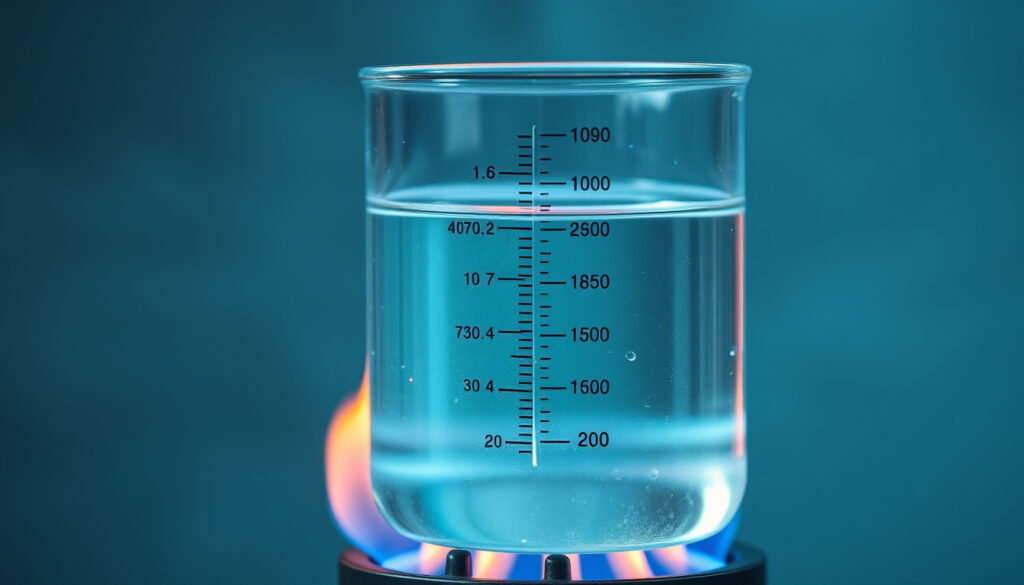
Specific Heat Capacity of Water: 4184 J/kg·K Value & Formula
Try standing in a lake on a cool autumn evening and you’ll notice something odd: the water feels warmer than the air, even though both have been losing heat since noon. That’s not a weather glitch — it’s a direct consequence of water’s specific heat capacity. Water can absorb enormous amounts of energy before its temperature climbs, and that single property shapes everything from coastal climates to the survival of life on Earth.
Standard Value: 4184 J/kg·K · Common Units: J/kg°C or cal/g°C · At 20°C: 4184 J/kg·K · Cp vs Cv: Cp ≈ 4184, Cv ≈ 4180 J/kg·K · Why It Matters: Moderates climate and daily weather
Quick snapshot
- Water absorbs 4184 J to raise 1 kg by 1°C (USGS Water Science School)
- 1 calorie = 4.184 J, defined by water’s specific heat (LibreTexts Biology)
- Oceans store over 90% of Earth’s added warmth (NOAA Climate.gov)
- Exact Cv at extreme pressures still requires precise measurement
- Regional seawater variations from salinity need further study
- Ocean heat storage has increased since 1993, hitting record high in 2015
- Climate models continue refining ocean heat uptake predictions using water’s specific heat
The standard table below lays out the key values you’ll encounter across physics, engineering, and climate science.
| Condition | Specific Heat (J/kg·K) |
|---|---|
| At 20°C (STP) | 4184 |
| At 0°C | 4186 |
| In cal/g·°C | 1 |
| At boiling point | 4217 |
| At freezing point | 4212 |
| Ice at 0°C | 2093 |
What is the specific heat of water in J kg C?
The standard value for liquid water at room temperature is 4184 J/kg·K. That number tells you exactly how much energy it takes to raise 1 kilogram of water by 1 kelvin — and since 1 K and 1 °C are the same step size, the same value holds for Celsius.
You can express this same quantity in several equivalent forms:
- 4184 J/kg·K — the SI standard
- 4184 J/kg·°C — common in engineering texts
- 4.184 kJ/kg·K — convenient for larger quantities
- 4.184 J/g·°C — often used in chemistry
- 1 cal/g·°C — the historical definition
The calorie itself is defined by water’s specific heat: one calorie raises 1 gram of water by exactly 1 °C, which equals 4.184 joules. For quick homework problems, instructors often accept 4200 J/kg·°C as a rounded value — close enough for estimation work.
When you see “4184 J/kg·K,” think: 4.184 kilojoules to heat one liter of water by one degree. That’s a lot of energy — which is exactly why water is such an effective thermal buffer.
Standard value at 20°C
The reference conditions are 20 °C and standard atmospheric pressure. Under those conditions, the isobaric specific heat (Cp) is precisely 4184 J/kg·K (Wikipedia). The isochoric value (Cv), measured at constant volume, runs slightly lower at approximately 4180 J/kg·K.
Units explained
The notation “J/kg·K” breaks down as:
- J — joules of energy
- kg — per kilogram of mass
- K — per kelvin of temperature change
This is an intensive property: it doesn’t depend on how much water you have, only on what the substance is. One kilogram of water and a thousand kilograms of water share the same specific heat.
What Is the Specific Heat of Water? How Is It Special?
Among common liquids, water has one of the highest specific heat capacities — roughly 4.186 J/g·°C, compared to air’s 1.005 J/g·°C (Virginia Institute of Marine Science). Most organic solvents fall between 1000–2500 J/kg·K; water’s 4184 J/kg·K sits well above that range.
The practical impact becomes obvious at the beach. Sand’s specific heat is about one-fifth of water’s, so it heats and cools rapidly. On a sunny summer day, sand can reach 60 °C while the ocean stays near 25 °C. Water absorbs five times more heat per degree of temperature change, buffering coastal temperatures and keeping beach-goers comfortable.
Comparison to other substances
The contrast is stark when you place water alongside common materials:
- Air: 1005 J/kg·K — water holds 4× more heat per gram
- Ice (at 0°C): 2093 J/kg·K — water holds 2× more heat than ice
- Aluminum: 897 J/kg·K — metals conduct heat faster and store less
- Sand: ~830 J/kg·K — one-fifth of water’s capacity
No common liquid exceeds water’s specific heat. This makes water uniquely valuable wherever thermal stability matters.
Role in nature
The high specific heat of water moderates Earth’s climate in ways that make life possible. Oceans absorb solar radiation during the day and release it slowly at night, smoothing out temperature extremes. Coastal regions experience narrower temperature swings than inland areas — a direct consequence of the ocean’s enormous heat capacity (Florida Atlantic University CES).
Oceans store over 90% of the excess heat trapped by greenhouse gases, and that heat uptake has been accelerating since the 1990s, reaching record levels in 2015. Water’s specific heat is why our oceans can absorb decades of climate forcing without boiling away — and why that heat will influence weather patterns for generations.
Without water’s high specific heat, Earth’s surface would swing from freezing nights to scorching days — like Mars, where temperature swings exceed 100°C daily. Water’s thermal buffering is what makes temperate climates possible.
How to explain specific heat capacity?
The concept is straightforward: specific heat capacity is how much energy a substance absorbs for each degree of temperature rise. Think of heating a pot of water on the stove — the burner adds energy, but the water doesn’t immediately get hot. That energy goes into increasing the motion of water molecules.
The formal relationship is the heat transfer equation:
Q = m c ΔT
Where Q = heat energy (J), m = mass (kg), c = specific heat capacity (J/kg·K), ΔT = temperature change (K or °C)
Simple analogy for beginners
Imagine two pans on the same burner — one with a liter of water, one with a liter of cooking oil. After five minutes, the oil is scalding while the water is still warm. Why? Oil has a lower specific heat. The same flame adds the same energy to both, but oil’s molecules respond faster, heating up more per joule absorbed.
Water is the opposite: it takes a lot of energy to raise its temperature, which is why it’s so effective at storing and transporting heat.
Formula breakdown
Working backward from the equation, specific heat capacity is:
- c = Q / (m × ΔT)
That means you determine a substance’s specific heat by adding a known amount of energy to a known mass, measuring the temperature change, and dividing. This is exactly what calorimetry experiments do.
For example, to warm 500 mL of water (0.5 kg) by 10°C, you need:
- Q = 0.5 kg × 4184 J/kg·K × 10 K = 20,940 J
That 20,940 joules is roughly what a 1000-watt microwave delivers in about 21 seconds.
What is Cp and Cv for water?
Specific heat is measured under two different conditions, and the difference matters for precise calculations:
- Cp (isobaric specific heat): Measured at constant pressure — the substance is allowed to expand as it heats. For water at 20°C, Cp = 4184 J/kg·K.
- Cv (isochoric specific heat): Measured at constant volume — the substance cannot expand. For water at 20°C, Cv ≈ 4180 J/kg·K.
The difference is small for liquids, but it exists because expanding against atmospheric pressure consumes some of the input energy. At constant pressure, part of the heat goes into the work of expansion rather than raising temperature.
Constant pressure vs volume
For engineering calculations involving water in open systems — boilers, heat exchangers, pipelines — Cp is the standard value. The isochoric value Cv applies to sealed containers where volume is fixed.
At the triple point (0.01°C, 611.657 Pa), water’s isobaric specific heat reaches a local maximum of 4.2199 kJ/kg·K (Engineering Toolbox). This anomaly reflects the complex molecular behavior near the phase boundary.
Values for liquid water
Water’s specific heat changes slightly with temperature, which matters for precision work:
- At 0°C: 4186 J/kg·K
- At 20°C: 4184 J/kg·K
- At 40°C: 4178 J/kg·K
- At 100°C: 4217 J/kg·K
- At 360°C: 15,004 J/kg·K (near critical point)
The value increases dramatically above 300°C as water approaches its critical temperature, where it begins transitioning from liquid to supercritical fluid.
For most everyday calculations — kitchen, lab, or climate work — use 4184 J/kg·K. The temperature variation is small enough to ignore unless you’re working above 100°C or below 10°C.
Specific heat capacity of water formula
The fundamental equation for heat transfer involving water is:
Q = m c ΔT
Where:
- Q = heat energy transferred (in joules, J)
- m = mass of water (in kilograms, kg)
- c = specific heat capacity of water (4184 J/kg·K)
- ΔT = temperature change (in kelvin, K, or °C — the interval is identical)
Basic formula
The rearranged form gives specific heat directly:
- c = Q / (m × ΔT)
This is how scientists determine specific heat experimentally: measure the energy added, measure the mass, measure the temperature change, divide.
Example problems
Problem 1: How much energy to heat 1 liter of water from 20°C to 60°C?
- m = 1 kg, ΔT = 40 K, c = 4184 J/kg·K
- Q = 1 × 4184 × 40 = 167,360 J (about 167 kJ)
Problem 2: A 2 kg block of aluminum (c = 897 J/kg·K) and 2 kg of water absorb the same 50,000 J. What are their temperature changes?
- Aluminum: ΔT = 50,000 / (2 × 897) = 27.9 K
- Water: ΔT = 50,000 / (2 × 4184) = 6.0 K
The same energy raises water’s temperature by only 6 degrees while aluminum climbs nearly 28 degrees — illustrating why water is the superior heat-storage medium.
High specific heat is a double-edged sword: water resists temperature change (great for stability), but it also requires substantial energy input to heat. Cold mornings demand patience when boiling water for coffee.
How to measure specific heat of water experimentally
Measuring water’s specific heat directly is a classic physics lab exercise. Here’s a straightforward approach using electrical heating:
- Measure mass: Weigh your water sample accurately (e.g., 260 mL = 0.26 kg).
- Record initial temperature: Take the starting temperature with a calibrated sensor.
- Apply known heat: Use an electrical heater with measured voltage and current (e.g., 6V × 1.2A = 7.2 W) for a timed interval.
- Record final temperature: Measure the temperature rise after heating.
- Calculate: Divide heat input (in joules) by mass × temperature change.
Typical student results yield values between 4.1 and 5.3 J/g·K — close to the accepted 4.186 J/g·°C but with measurement uncertainty (Western University Physics Lab). Discrepancies come from heat loss to the surroundings, incomplete insulation of the calorimeter, and sensor lag.
A properly insulated calorimeter (often built from nested Styrofoam cups) reduces losses and improves accuracy. The best student measurements cluster around 4.2 ± 0.2 J/g·K, confirming the theoretical value to within a few percent.
The climate connection
Water’s high specific heat isn’t just a laboratory curiosity — it’s a planetary-scale climate regulator. Understanding this connection reveals why Earth’s ocean-dominated surface remains habitable while drier planets experience extreme temperature swings.
Oceans cover 71% of Earth’s surface and absorb over 90% of the excess heat trapped by greenhouse gases (NOAA Climate.gov). That heat storage capacity has buffered the full impact of climate change — without the ocean’s thermal mass, atmospheric warming would be far more severe.
Coastal climates illustrate this effect daily. During summer, the ocean absorbs huge quantities of solar energy without much temperature rise. At night, that stored heat slowly releases, moderating coastal temperatures. In contrast, inland areas — with little water to buffer heating and cooling — experience much larger daily swings.
The Great Lakes region of North America demonstrates this clearly. Lake Michigan’s thermal mass extends the swimming season into autumn and moderates winter snowfall. Since the 1970s, decreasing ice cover on the Great Lakes has altered this balance as more open water absorbs and releases heat faster.
Wherever water dominates the surface — oceans, large lakes, sea-breeze coastlines — temperature extremes soften. Where land dominates, daily swings sharpen. Water’s specific heat is the physical reason for that difference.
“Ocean warming accounts for over 90% of the warming in Earth’s climate system.”
— NOAA Climate.gov (Government Agency)
“Water has the highest specific heat capacity of any liquid.”
— LibreTexts Biology (Educational Resource)
What makes water so thermally stubborn? The answer lies in its hydrogen-bond network. Each water molecule can form up to four hydrogen bonds with neighbors, creating a dynamic molecular structure that absorbs vibrational energy efficiently. When you add heat to water, much of it gets captured in these hydrogen bonds before translating into measurable temperature rise.
The implication for climate science is profound: as long as Earth’s oceans retain their high specific heat, the planet’s surface temperature will moderate around a relatively narrow range. That stability has persisted for millennia — and its disruption, as oceans absorb ever more heat, will reshape weather patterns worldwide.
Upsides
- Stabilizes coastal and global climates
- Enables efficient heat exchangers and cooling systems
- Makes Earth’s surface habitable (vs. extreme swings on dry planets)
- Stores renewable thermal energy for later use
Downsides
- Requires significant energy to heat
- Slow to respond to sudden temperature changes
- High heat capacity amplifies ocean heat storage, accelerating warming
- Complicates climate models (but necessary for accuracy)
For engineers designing cooling systems, water’s high specific heat means each kilogram can absorb substantial thermal load without significant temperature rise — ideal for heat removal. For climate scientists, it means ocean heat content serves as a long-term accumulator of global warming. For anyone boiling a kettle, it means patience: warming water takes time precisely because it holds so much energy per degree.
Related reading: Water Softener Near Me
scribd.com, youtube.com, high-school-physics-lessons.blogspot.com, khanacademy.org
Frequently asked questions
Is 0°C equal to 273 K?
Yes. The Kelvin scale starts at absolute zero (0 K), and 0°C equals 273.15 K. The size of one degree is identical on both scales, so adding 273.15 converts Celsius to Kelvin. This matters in specific heat calculations because ΔT in kelvin equals ΔT in Celsius — the interval is the same.
Is specific heat capacity for 1 g or 1 kg?
It can be expressed for either. Common forms are J/kg·K (SI standard) or J/g·°C (chemistry). The difference is a factor of 1000: 4184 J/kg·K = 4.184 J/g·°C. Either is correct; just match your units when calculating.
What is specific heat for dummies?
Specific heat is how much “stuff” is inside a temperature change. Imagine two equal-weight objects — one water, one metal — sitting in the same sun. The metal gets hot fast; the water heats slowly. Water’s specific heat is higher because it takes more energy to raise its temperature. That’s why oceans warm slowly and cool slowly, moderating climate.
How does specific heat capacity of water vary with temperature?
Water’s specific heat decreases slightly from 0°C to about 40°C (minimum around 30–40°C), then rises gradually. Near the critical point (374°C), it increases dramatically. For most practical purposes between 0–100°C, the variation is small enough to ignore, using 4184 J/kg·K as a constant.
Why is specific heat capacity of water high?
Water molecules form strong hydrogen bonds with each other. When you add heat energy, much of it goes into breaking and re-forming these bonds before the molecules move faster (which we measure as temperature rise). This molecular “storage” mechanism is why water resists temperature change more than most substances.
Specific heat capacity of water practical uses?
Applications include: engine coolant (absorbs engine heat without boiling), HVAC systems (water efficiently transfers thermal energy), climate moderation (oceans buffer temperature extremes), cooking (water’s high c means slow heating), and solar thermal storage (heated water retains energy for nighttime use).
Specific heat of water in cal/g°C?
By definition, water’s specific heat is exactly 1 cal/g·°C. This is how the calorie was historically defined: one calorie raises one gram of water by one degree Celsius. Since 1 cal = 4.184 J, the SI value 4184 J/kg·K is precisely equivalent.
More related posts
 The Mitchells vs. the Machines – Plot, Cast and Netflix Guide
 Où Regarder Dodgers – Blue Jays – Full TV and Streaming Guide
 Inter Milan vs FC Barcelona: History, Results & How to Watch
 Zach Bryan I Remember Everything Lyrics – Full Text, Meaning & Chords
 Who Called Me from This Phone Number? Free Lookup Guide
 NHL Trade Deadline 2025 – Date, Key Trades, Rules and Analysis
 Work From Home Jobs Ontario: 2107+ Remote Openings
 Poker Face Season 2 – Premiere Date Cast Renewal Facts