Best Ajiaco Colombiano Near Me: Top Spots & Delivery
Few Colombian soups command the devoted following that ajiaco enjoys in Bogotá. Whether you’re a city native or an expat discovering this golden, potato-rich broth for the first time, the search for “best ajiaco colombiano near me” tends to lead to the same handful of names—names that locals mention with the same reverence others reserve for a grandmother’s recipe. The good news: the best bowls aren’t hidden in private clubs or reservation-only dining rooms. They’re often found in modest rooms with plastic chairs, sticky menus, and lines that form before the doors open.
Origin City: Bogotá · Key Ingredients: Chicken, potatoes, corn, cilantro · Top Review Spot: El Mejor Ajiaco del Mundo · Delivery Platforms: DoorDash · Signature Serve: With capers and avocado
Quick snapshot
- Ajiaco originates from Bogotá and uses three distinct potato varieties (Tripadvisor)
- The dish combines chicken, corn on the cob, cilantro, and locally called “papa criolla” (Tripadvisor)
- Traditional service includes capers, avocado, and heavy cream as garnishes (Tripadvisor)
- Whether ajiaco or bandeja paisa holds the broader “national dish” recognition beyond Bogotá (Tripadvisor)
- Exact ingredient proportions vary by household and restaurant (Tripadvisor)
- La Puerta Falsa has operated from its 200-year-old building near Plaza Bolívar for generations (Tripadvisor)
- Delivery expansion through platforms like DoorDash is making Bogotá ajiaco accessible outside the Candelaria district (DoorDash)
What is ajiaco colombiano?
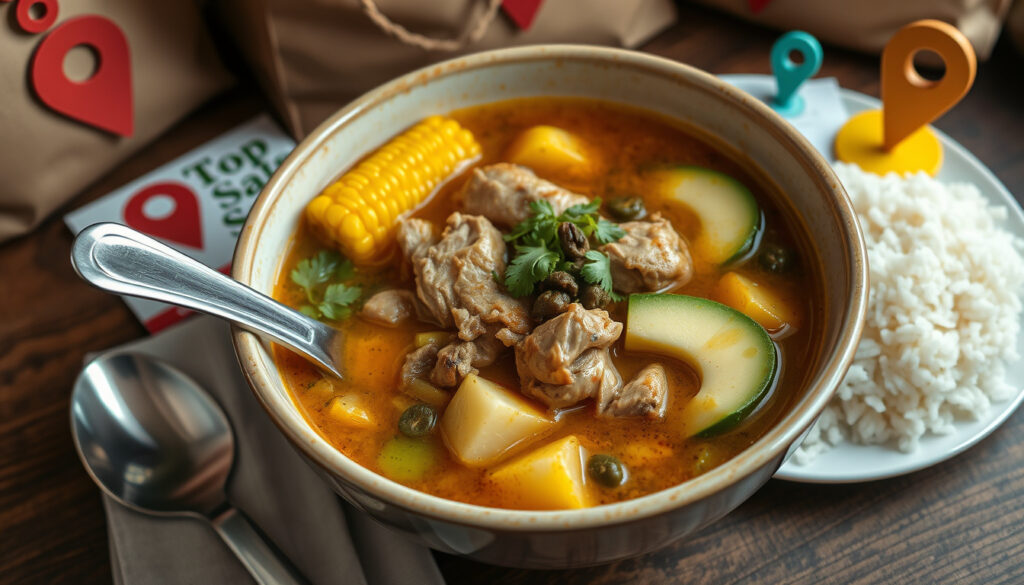
Ajiaco colombiano is a thick, golden chicken soup that differs sharply from most other Latin American soups. Where typical chicken soups are clear broths, ajiaco owes its deep color and starchy body to papa criolla—a small, yellow Peruvian potato that breaks down during cooking. The result is something between a soup and a stew, rich enough to hold a spoon upright.
Key ingredients
- Chicken (usually a whole bird, simmered for hours)
- Three potato varieties: papa criolla, papa pastusa, and papa sabanera (Tripadvisor)
- Corn on the cob
- Cilantro
- Capers, avocado slices, and heavy cream (added at the table)
Traditional preparation
Restaurants like La Puerta Falsa—a 20-seat room in a 200-year-old building near Plaza Bolívar—prepare ajiaco by simmering chicken with aromatics for extended periods, then adding potatoes in stages (Tripadvisor). The papa criolla thickens the broth naturally. No cornstarch, no roux—just time and the right potatoes.
Ajiaco is not a weeknight rushed soup. The best versions take hours. If a restaurant serves it fast, the broth likely came from a powder.
Where in Colombia is ajiaco especially popular?
Ajiaco is unequivocally a Bogotá dish. Unlike bandeja paisa, which spans the Andean region, ajiaco carries a specific Bogotá identity. Locals treat it as a Saturday ritual—often called “sopa de sábado” in some neighborhoods—and most of the celebrated spots cluster within the Candelaria district and nearby Laureles.
Bogotá origins
El Mejor Ajiaco del Mundo ranks #187 out of 5,771 restaurants in Bogotá on Tripadvisor, with 279 reviews and a price range of $$ to $$$ (Tripadvisor). Located at Calle 11 6 20 in Candelaria, the restaurant serves main dishes between 14,000–16,000 COP (roughly $3.50–$4 USD) with juices starting at 3,000 COP and desserts at 4,000 COP (Tripadvisor). It stays open until 8:00 PM.
Medellín spots
Medellín visitors report fewer dedicated ajiaco specialists compared to Bogotá. The neighborhood of Laureles does host several spots where expats and digital nomads congregate, though specific restaurant names and ratings appear less consistently documented in major review platforms compared to Bogotá alternatives.
If you’re searching from outside Colombia, the supply of verified, high-rated ajiaco drops sharply outside Bogotá. Delivery platforms have started bridging that gap, but quality control remains inconsistent.
Is ajiaco good?
The short answer from reviewers is a qualified yes—with the caveat that “good” depends heavily on expectations. Ajiaco is not a punchy, herb-forward broth. Its flavors are subtle, starchy, and build slowly on the palate. Travelers accustomed to bold, clear soups often describe it as bland at first bite, then addictive by the third spoonful.
Taste profiles
The dish operates on a flavor logic where the garnish tray does much of the work. Fresh avocado adds creaminess, capers deliver salt and brine, and heavy cream rounds the edges. Diners who skip the garnish bar leave disappointed. Those who build each bowl intentionally tend to become regulars.
Common praises
Tripadvisor reviewers frequently mention the portion sizes as exceptional—large enough for two meals from a single bowl. The combination of chicken, potato, and corn satisfies hunger in a way that lighter soups cannot. Multiple reviewers from expat communities describe finding ajiaco “by accident” in Candelaria and returning weekly.
Good ajiaco. The portions were huge. Can’t believe the price—maybe 4 USD for a bowl that could feed two.
— Tripadvisor reviewer, El Mejor Ajiaco del Mundo
What is Colombia’s most famous dish?
This question generates more disagreement than almost any other in Colombian food circles. Bandeja paisa—featuring red beans, rice, ground beef, chicharrón, fried egg, plantain, and arepa—claims the broadest recognition as Colombia’s “national dish” in international food writing and restaurant menus abroad. Ajiaco, meanwhile, holds a more regional but fiercely loyal status centered on Bogotá.
Ajiaco vs bandeja paisa
The distinction matters for practical reasons. Bandeja paisa is an energy-dense plate designed for hard labor; ajiaco is a restorative soup for cool mountain afternoons. They appeal to entirely different eating occasions. Travelers planning a food itinerary should treat both as essential rather than competing options.
National dish debate
Colombians themselves resist a single answer. Regional pride runs deep—Antioqueños champion their Paisa cuisine, costeños defend coastal seafood, and Bogotanos quietly consider ajiaco their culinary gift to the nation. No Colombian government body has ever officially designated a national dish, which may be why the debate persists without resolution.
Ajiaco is the best soup in Colombia. I tell every visitor: you haven’t been to Bogotá until you’ve sat in a tiny restaurant eating this with your hands, adding capers one by one.
— Reddit user, r/Colombia
“Ajiaco” on a menu outside Colombia—particularly in North American cities—frequently means a different, simplified soup. If authenticity matters, look for restaurants advertising Bogotá-style preparation, specify “con papa criolla,” or ask about garnish trays.
Best ajiaco colombiano near me options
The “near me” question has two practical answers depending on your location: inside Colombia or outside it.
Top Reddit picks
Reddit’s r/Colombia and r/bogota communities consistently mention La Puerta Falsa and El Mejor Ajiaco del Mundo as the two must-visit spots in Candelaria. Ireland-based visitors posting trip reports confirm these recommendations, noting the lines form early and the service is fast despite the cramped space. Casa Vieja also surfaces in expat discussions, though verification of current ratings and pricing requires direct confirmation.
Delivery via DoorDash
DoorDash has expanded its Bogotá coverage, with Chao Pescao and Arepas Inc appearing in delivery searches for “ajiaco.” These platforms aggregate orders from multiple restaurants, so quality consistency varies by preparation time and distance. Reviewers suggest ordering during off-peak hours for better results.
Three Bogotá restaurants appear most frequently in verified reviews and community discussions.
| Restaurant | Location | Tripadvisor Rank | Price Range (COP) |
|---|---|---|---|
| El Mejor Ajiaco del Mundo | Calle 11 6 20, Candelaria | #187 of 5,771 | 14,000–16,000 |
| La Puerta Falsa | Near Plaza Bolívar | Top 50 mentions | Moderate |
| Casa Vieja | Bogotá (specific area varies) | Consistently referenced | Moderate |
The pattern is clear: Candelaria dominates recommendations, while restaurants outside that district require extra verification before visiting.
Related reading: Easy Chilean Recipes at Home: Authentic Dishes for Beginners · Salmon in the Oven: Times, Foil Tips & Chef Recipes
Frequently asked questions
What makes ajiaco colombiano unique?
Ajiaco uses three potato varieties—including papa criolla, which thickens the broth naturally without thickeners. The result is a creamy, golden soup distinct from clear chicken broths in other traditions.
How do I find ajiaco delivery near me?
DoorDash covers select Bogotá restaurants, though delivery quality depends on preparation-to-delivery time. Search “ajiaco” on the platform and filter by highest-rated sellers with recent reviews.
Is ajiaco spicy?
No. Standard ajiaco contains no chili heat. The seasoning comes from cilantro and the saltiness of capers. Hot sauce is available on tables but is not traditional.
What to pair with ajiaco?
Most restaurants serve ajiaco with rice, patacones (fried plantains), and fresh lime. A side of arepa also appears frequently. For drinks, tropical fruit juices—lulo, maracuyá—are canonical.
Can vegetarians eat ajiaco?
Traditional ajiaco centers on chicken, so the base is not vegetarian. Some restaurants offer a vegetable-adapted version, but this lacks the authentic depth and should be requested explicitly before ordering.
How much does ajiaco cost?
At El Mejor Ajiaco del Mundo, main dishes range from 14,000 to 16,000 COP (approximately $3.50–$4 USD). Add beverages and dessert, and a full meal runs under $6–$7 USD.
Is ajiaco served year-round?
Yes. Unlike some regional soups associated with cold weather or holidays, ajiaco is a staple in Bogotá restaurants regardless of season. It appears on menus in January and July alike.
Summary
For travelers landing in Bogotá, the path to a memorable ajiaco is well-worn: head to Candelaria, pick between El Mejor Ajiaco del Mundo and La Puerta Falsa based on your tolerance for crowds, and commit to the full garnish tray. For readers outside Colombia wondering if ajiaco travels well via delivery, the honest answer is “partially”—you’ll get the ingredients, but not the atmosphere that makes the dish legendary. Tourists who prioritize authentic experience over convenience will find the extra effort to reach these restaurants pays dividends in flavor and memory.
More related posts
 Drive Test Near Me: Find RSA Centres & Book in Ireland
 The Mitchells vs. the Machines – Plot, Cast and Netflix Guide
 Wentworth Miller: Autism, Coming Out, and Life Now
 Jackson Browne: Biography, Songs, and Relationship Facts
 John Tory Wife Illness – Aileen’s Cancer Timeline 2018-2021
 Poker Face Season 2 – Premiere Date Cast Renewal Facts
 Pound to Canadian Dollar: Live Rate, Forecast & Conversion Tips
 Boeing 787-9 Seat Map: Layout, Best Seats & Comfort Guide