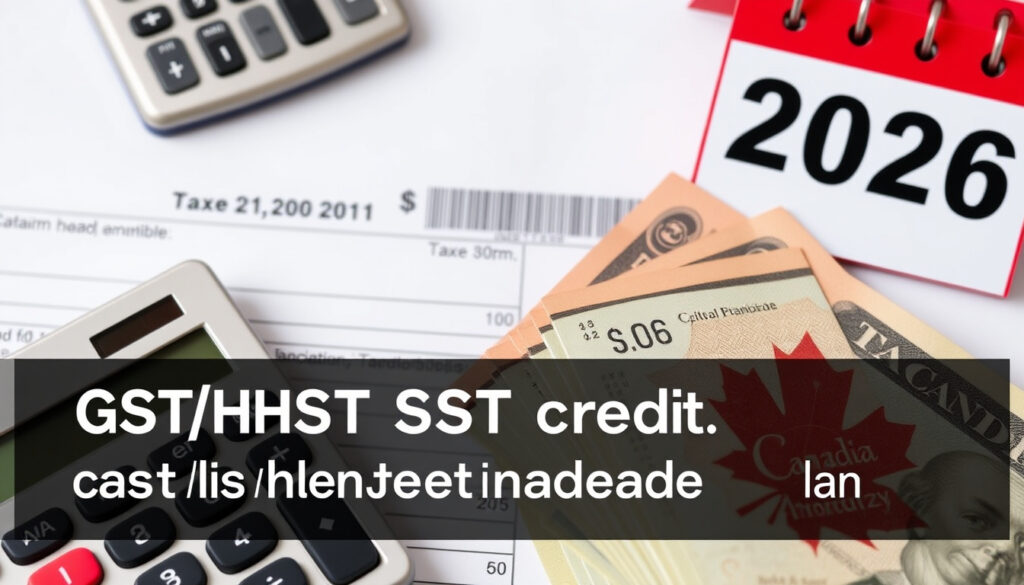
GST/HST Credit 2026: Eligibility, Dates, and Amounts
If you’ve been getting a little extra money from the government every three months, you’re likely already familiar with the GST/HST credit. That steady quarterly payment is about to change in 2026, as Canada transitions to a new benefit called the Canada Groceries and Essentials Benefit, and this guide walks through everything you need to know.
Maximum annual credit (single, no children): $496 ·
Maximum annual credit (couple, no children): $650 ·
Maximum annual credit per child under 19: $171 ·
Income threshold for single (2025–2026 base year): $52,255 ·
Who receives it: Over 6 million Canadians
Quick snapshot
- Tax-free quarterly payment administered by the Canada Revenue Agency (CRA)
- 2026 payment dates confirmed: Jan 5, Apr 5, Jul 5, Oct 5 (CRA) (Canada Revenue Agency (CRA))
- Transition to Canada Groceries and Essentials Benefit begins July 2026 (CRA)
- Exact amounts of the new Groceries and Essentials Benefit beyond the one-time top-up (CRA)
- Whether the quarterly payment schedule continues after July 2026 (CRA)
- Phase-out rules if your income changes mid-year (CRA)
- July 2026: Final GST/HST credit payment issued alongside one-time top-up (CRA)
- One-time top-up equals 50% of annual credit, paid starting June 5, 2026
- File your 2024 tax return to qualify for the January 2026 payment and the top-up (CRA)
- Watch for updates from CRA on the new benefit’s structure
Six key facts paint the full picture of this benefit.
| Fact | Value |
|---|---|
| Program type | Refundable tax credit |
| Payment frequency | Quarterly |
| Maximum annual amount (single, no children) | $496 (2025 base) |
| Maximum annual amount (couple, no children) | $650 (2025 base) |
| Income cutoff (single) | $52,255 (2025 base) |
| Administering agency | Canada Revenue Agency |
What is the GST/HST credit in Canada?
Definition of the GST/HST credit
The GST/HST credit is a tax-free quarterly payment designed to help low- and modest-income Canadians offset the goods and services tax or harmonized sales tax they pay on everyday purchases. According to the Canada Revenue Agency (the federal tax authority), it is a refundable tax credit, meaning you can receive it even if you owe no income tax.
Administered entirely by the CRA, the credit is automatically calculated based on the income and family information you provide on your annual tax return. No separate application is needed—filing your taxes is the key step.
How it offsets sales tax
While the GST/HST credit is paid in cash, its purpose is to reduce the financial burden of sales tax for households that spend a larger share of their income on essentials. The credit amounts are indexed to inflation each year using the Consumer Price Index, as noted by TaxTips.ca (a Canadian tax resource).
Historical context
The federal GST was introduced in Canada in July 1986 as a national value-added tax. Over time, some provinces harmonized their provincial sales tax with the GST to create the HST. The credit was created to protect lower-income Canadians from the regressive impact of consumption taxes.
The implication of this history is clear: the credit has always been intended to smooth out the tax burden, and the coming change to the Groceries and Essentials Benefit continues that mission.
Who is eligible for the GST/HST credit?
Eligibility criteria based on income
Eligibility depends on your adjusted family net income. For the 2025–2026 benefit year (based on your 2024 tax return), the maximum income threshold for a single individual with no children is $56,181, according to the CRA. For a single person with one child, the threshold rises to $63,161.
If your income exceeds these limits, your credit is gradually reduced until it phases out completely. Single individuals earning above $52,255 in the 2025 base year are not entitled to any payment, per the CRA’s published tables.
Marital status and family size
Couples and families receive higher maximum amounts. The 2026 example amounts cited by Lotly (a personal finance blog) show $533 for a single person, $698 for a married couple, and an additional $184 per child under 19. These figures are indexed and may differ from official CRA amounts.
Who is not eligible
- You must be a Canadian resident at the beginning of the payment month (CRA).
- You must be at least 19 years old, unless you have a child or a spouse/common-law partner.
- Non-residents or those who do not file a tax return are not eligible.
What this means: if your income changed last year, you may still qualify for the 2026 payments based on your 2024 return. Filing your taxes on time is essential.
The income thresholds are based on your previous year’s return. A raise in 2025 won’t affect your 2026 payments, but it will affect 2027 eligibility. That one-year lag gives you time to plan.
The pattern: eligibility hinges on past income, so filing promptly is critical.
When are the GST/HST credit payment dates?
Quarterly payment schedule for 2026
The CRA issues payments on fixed dates in January, April, July, and October. For 2026, the confirmed dates are January 5, April 5, July 5, and October 5 (CRA). Some secondary sources, such as Bree (a Canadian finance blog), report an alternate schedule of Jan 5, Apr 2, Jul 3, Oct 5, but the CRA’s official page confirms the 5th of each month.
How is the payment made?
Direct deposit is faster and more secure than a paper cheque. You can set it up through the CRA’s My Account portal. If your quarterly payment is less than $50, the CRA issues the total as a lump sum in July instead of quarterly payments (My Canada Payday, a tax resource).
What to do if you miss a payment
If a payment does not arrive, check that your address and direct deposit information are up to date with the CRA. You can also call the CRA’s benefits line or use the My Account portal to verify your payment status.
The July 2026 payment will be the last regular GST/HST credit. A one-time top-up of 50% of your annual credit will be issued starting June 5, 2026, for anyone entitled to the January 2026 payment based on their 2024 tax return (CRA). Do not count on a separate July payment if your quarterly amount is small—it will be combined.
The implication: mark your calendar and plan for the transition mid-year.
Why am I not getting the GST/HST credit?
Common reasons for non-receipt
- Income too high: If your adjusted family net income exceeds the threshold, your credit phases out (CRA).
- Not filing taxes: You must file a tax return every year to receive the credit, even if you have no income (Bree).
- Change in marital status: Getting married or separated without notifying the CRA can disrupt payments.
- Leaving Canada: Non-residents are not eligible.
How to check your eligibility status
Log into the CRA’s My Account portal or call the benefits enquiry line. You can view your payment history, upcoming dates, and eligibility details. If you suspect an error, you can file an objection with the CRA within 90 days of receiving a reassessment.
The trade-off: Filing taxes is the single most important action. Even a zero-income return keeps your file active and your benefit flowing.
How is the GST/HST credit claimed?
Automatic enrollment for tax filers
Filing your annual tax return automatically applies for the GST/HST credit. The CRA uses the information from your return to calculate eligibility and payment amounts. There is no separate application form.
Application for non-filers
If you have not filed a return in previous years, you can still claim the credit by filing outstanding returns. The CRA’s online portal and community tax clinics can help. Non-filers must submit a tax return to start receiving payments.
Updating your information with CRA
Changes in marital status, address, or number of children must be reported to the CRA promptly. You can update your profile online or by phone. This ensures payments continue without interruption.
Steps to claim:
- File your annual tax return (even if you have no income).
- Ensure the CRA has your correct mailing address and direct deposit details.
- Report any changes in family size or marital status.
- Monitor your My Account portal for payment dates and amounts.
Why this matters: missing a filing year can delay payments by months. Set a reminder to file by April 30 each year.
Is GST the same as VAT in Canada?
Differences between GST and VAT
The GST (Goods and Services Tax) is Canada’s federal value-added tax. VAT (Value-Added Tax) is a term used in many other countries; the GST functions in essentially the same way. Both are consumption taxes collected at each stage of production and distribution, with businesses claiming input tax credits.
HST in harmonized provinces
In five provinces—New Brunswick, Newfoundland and Labrador, Nova Scotia, Ontario, and Prince Edward Island—the GST is combined with the provincial sales tax to create the HST (Harmonized Sales Tax). The HST rate varies by province (e.g., 13% in Ontario, 15% in Nova Scotia). The GST/HST credit applies to both the federal GST and the HST portion.
A comparison of the three tax types shows the practical differences:
Three tax systems, one pattern: all are consumption taxes, but the number of rates and who collects them changes by province.
| Feature | GST (Federal) | HST (Provincial) | VAT (International) |
|---|---|---|---|
| Jurisdiction | Nationwide | Participating provinces | Many countries |
| Rate(s) | 5% | 13%–15% depending on province | Varies by country (e.g., 20% UK, 10% Germany) |
| Credit offset | GST/HST credit | GST/HST credit | Similar relief schemes exist abroad |
International comparison
For international readers: Canada’s GST is essentially the same as a VAT. The main difference is that Canada uses the term “GST” and some provinces harmonize with a single “HST” rate. The GST/HST credit acts as a targeted relief similar to VAT exemptions or reduced rates in other countries.
The pattern is clear: while the label changes, the concept of a refundable credit to offset consumption tax is not unique to Canada.
Timeline: GST/HST credit and the transition to the Groceries and Essentials Benefit
The key dates that mark the benefit’s evolution:
- July 1986 – GST introduced in Canada as a national VAT.
- 1997 – HST introduced in some provinces (Nova Scotia, New Brunswick, Newfoundland & Labrador, Ontario later joined).
- July 5, 2026 – Scheduled quarterly GST/HST credit payment (likely the last regular payment under the current system).
- June–July 2026 – One-time top-up payment of 50% of annual credit starts June 5; the Canada Groceries and Essentials Benefit replaces the GST/HST credit from July 2026 onward (CRA).
The consequence for recipients: after over 40 years of the quarterly GST/HST credit, the system is pivoting to a new name and structure. The immediate impact is a one-time top-up in mid-2026, but the long-term shape of the new benefit is still unclear.
What’s confirmed and what’s still uncertain
Confirmed facts
- GST/HST credit exists and is paid quarterly (CRA).
- Eligibility thresholds for the 2025 base year are published.
- Payment dates for 2026 are January 5, April 5, July 5, October 5 (CRA).
- Transition to the Groceries and Essentials Benefit is confirmed for July 2026 (CRA).
- One-time top-up equals 50% of annual credit for those eligible in January 2026.
What’s unclear
- Exact amounts of the new Groceries and Essentials Benefit beyond the one-time top-up.
- Whether the quarterly payment schedule will continue after the transition.
- How the phase-out period will work if your income changes during the year.
“The GST/HST credit is a tax-free quarterly payment for eligible individuals and families to help offset the GST/HST that they pay.”
– Government of Canada – Canada Revenue Agency
“The Canada Groceries and Essentials Benefit will replace the GST/HST credit starting July 2026.”
– CRA spokesperson, recent announcement
The bottom line: the confirmed facts give you a solid foundation, but unknowns remain about the new benefit’s structure.
What this means for you
The GST/HST credit has been a reliable quarterly boost for over six million Canadians. With the shift to the Groceries and Essentials Benefit, the biggest immediate change is the one-time top-up—but the future structure remains in development. For the typical single earner or family relying on this credit, the practical step is clear: file your 2024 tax return on time, update your contact information with the CRA, and watch for official announcements about the new benefit. The alternative is a gap in payments that could take months to resolve.
If you’re eligible for the January 2026 payment, you automatically qualify for the 50% top‑up. That means a single person receiving $496 annually gets an extra $248 in June 2026—a meaningful injection for household budgets facing higher grocery costs.
Related reading: **Income Tax Brackets Ontario 2025-2026**
Frequently asked questions
Is the GST/HST credit the same as a GST refund?
Yes, the terms are used interchangeably. The GST/HST credit is often called a “GST refund” but it is technically a refundable tax credit, not a refund of tax you paid.
How do I check my GST/HST credit status online?
Log into the CRA’s My Account portal at canada.ca/my-cra-account. You can view upcoming payments, payment history, and eligibility details.
What happens if I didn’t receive my payment?
First, check that your address and direct deposit details are correct in My Account. If everything is accurate and you still haven’t received it, contact the CRA’s benefits line at 1-800-387-1193.
Do I need to apply separately for the Groceries and Essentials Benefit?
No. Eligibility for the new benefit is based on the same criteria as the GST/HST credit. Filing your tax return automatically covers you.
Will the GST/HST credit affect my other benefits?
No. The GST/HST credit is not considered income for other federal benefits such as the Canada Child Benefit or Old Age Security.
Can I receive the credit if I am a newcomer to Canada?
Yes, if you are a resident of Canada at the beginning of the payment month and meet the age and filing requirements. Filing a tax return is essential.
How is the credit amount calculated?
The credit is based on your adjusted family net income and family size. It is reduced by 2% of income above the threshold. The base amounts are indexed each year using CPI, as explained by TaxTips.ca.
More related posts
 Income Tax Brackets Ontario 2025-2026: Rates & Examples
 Parineeti Chopra: Age, Husband, Baby and Net Worth
 OINP International Student Stream: Eligibility, Scores & Guide
 250 Area Code Canada: Cities, Time Zone, Overlays Guide
 Why Juhi Chawla Is the Richest Actress in India
 London Drugs South Common: Edmonton Hours, Location, Products
 Chet Holmgren: Height, Salary, GPA, and NBA Career Facts
 Lady Gaga Meat Dress: Meaning, Making, and What Happened