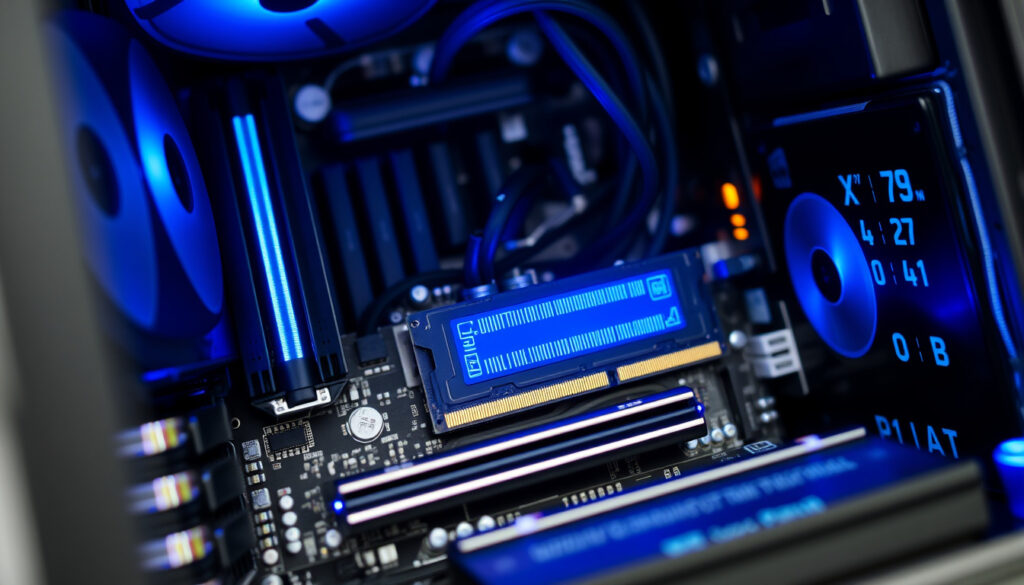
Random-Access Memory: What Is RAM and How Much Do You Need?
If you’ve ever wondered why your laptop slows down when you have too many tabs open, the answer usually lives in one component: RAM. Random-access memory is the short-term workspace your computer uses to keep things running smoothly, and getting the right amount can mean the difference between a machine that chugs and one that glides. Here’s what you need to know to buy smart.
Full form: Random Access Memory · Primary function: Stores working data and machine code · Access type: Any order, not sequential · Common capacities: 8GB, 16GB, 32GB · Typical use: Short-term memory for processor
Quick snapshot
- RAM allows random access to any byte of data directly, unlike tape that must be wound sequentially (GEEKOM)
- DDR5 operates at 1.1V, lower than DDR4’s 1.2V, improving power efficiency for laptops (GEEKOM)
- Laptop RAM uses SO-DIMM form factor, smaller than desktop DIMM modules (Best Buy Blog)
- Specific benchmarks for real laptop battery life impact between DDR4 and DDR5 remain limited
- Regional price differences for laptop RAM modules are not well documented in available sources
- Compatibility data for specific 2026 laptop models with upgradeable RAM slots varies by manufacturer
- DDR4 launched in 2014, still used for upgrades (Acer Corner)
- DDR5 launched in 2020 starting at 4800 MT/s (Best Buy Blog)
- DDR5 becomes mandatory for Intel Arrow Lake platforms in 2026 (DropReference)
- New laptop purchases in 2026 will predominantly feature DDR5 as standard
- DDR4 recommended only for upgrading existing systems, not new builds
- DDR5 standardization reaching 6400 MHz and beyond in consumer laptops
These specifications directly affect laptop performance, battery life, and upgrade costs.
| Attribute | Value |
|---|---|
| Speed access | Any location directly |
| Volatile | Loses data without power |
| Standard today | DDR4/DDR5 |
| DDR5 max data rate | 4800 MT/s initial |
| DDR4 max data rate | 3200 MT/s |
| DDR5 max capacity per module | 128GB |
| DDR4 max capacity per module | 64GB |
| DDR5 max bandwidth | 64 GB/s |
| DDR4 max bandwidth | 25.6 GB/s |
| Laptop RAM form factor | SO-DIMM |
What is a Random Access Memory?
Random-access memory (RAM) is the electronic computer memory that can be read and changed in any order, meaning the computer can access any bit of information directly without having to search through preceding data. This contrasts with sequential access storage like magnetic tape, where data must be wound through to reach a specific point. RAM serves as the workspace where your processor keeps data and machine code currently in use.
RAM Full Form
RAM stands for Random Access Memory—a name that directly describes its defining characteristic. Unlike storage drives that hold data permanently, RAM is volatile, meaning it loses everything when power is cut. Think of it as your desk versus a filing cabinet: RAM is the surface you work on right now, while your SSD or hard drive is the cabinet where files wait between sessions.
How RAM Works
When your processor needs to access data, it pulls it from slower storage into RAM for quick retrieval. The more RAM you have, the more applications and data your system can keep ready at once. HP’s tech guide (major laptop manufacturer) explains that RAM acts as short-term memory where data is stored as the processor needs it, affecting how smoothly you multitask.
RAM capacity matters more than speed for everyday tasks. Lexar (memory manufacturer) notes that prioritizing capacity over speed is generally a good rule of thumb for most users browsing the web or working in office applications.
For most laptop buyers, choosing a machine with more RAM delivers more noticeable improvement than paying extra for faster memory modules.
What Is Computer and Laptop RAM and Why Does It Matter?
RAM in laptops serves the same core purpose as desktop RAM but uses smaller SO-DIMM modules instead of full-size DIMMs. Best Buy’s buying guide (consumer electronics retailer) emphasizes that laptop RAM is physically smaller to fit portable designs, and some models use soldered memory that cannot be upgraded.
Role in Computing
Every application you run loads into RAM. When you open a web browser, the operating system allocates portion of RAM to handle tabs, plugins, and active content. When you switch between programs, each one stays resident in memory so switching feels instant. Without enough RAM, your system resorts to using storage as virtual memory, which slows everything down noticeably.
Impact on Performance
RAM speed, measured in MHz or MT/s (megatransfers per second), determines how quickly data moves between memory and processor. However, Lexar (memory manufacturer) clarifies that while RAM speed affects data processing, capacity is the more critical factor for multitasking. A system with slower but ample RAM will outperform one with fast but insufficient memory for your workload.
Laptops with soldered RAM—common in ultra-thin designs—cannot be upgraded later. Lenovo’s guide (leading laptop OEM) recommends checking your laptop specs for RAM type, channel configuration, upgradeability, and maximum supported RAM before purchasing.
If you buy a thin-and-light laptop with soldered memory, you are stuck with whatever capacity it shipped with for the machine’s entire lifespan.
What are the three types of RAM?
The main types of RAM found in modern computers are DRAM (Dynamic RAM) and SRAM (Static RAM), with DDR variants being the dominant form in consumer devices. DDR stands for Double Data Rate, and current laptops use either DDR4 or DDR5 modules.
DRAM
Dynamic RAM uses capacitors that must be periodically refreshed to maintain data, which makes it slower but cheaper to manufacture. This is the technology behind the DDR4 and DDR5 modules you’ll find in most laptops today.
SRAM
Static RAM uses flip-flop circuits that maintain data without refresh, making it faster but significantly more expensive and power-hungry. SRAM appears in CPU caches rather than system memory modules.
Other Variants
DDR5 represents the current generation, with notable improvements over DDR4. InnoAioT’s comparison guide (tech analysis outlet) details that DDR5 starts at 4800 MT/s, providing over 85% performance increase over DDR4, and includes a built-in Power Management IC (PMIC) for better efficiency.
The takeaway for buyers: DDR5 is now the standard for new laptops, while DDR4 remains viable only for upgrading older machines still on that platform.
Do I need 8GB or 16GB of RAM?
The amount of RAM you need depends entirely on how you use your laptop. HP’s recommendations (laptop manufacturer with decades of design experience) break this down clearly by use case.
For Basic Use
For web browsing, document creation, and email, 4GB RAM is sufficient for light tasks. If you frequently keep multiple browser tabs open or work with larger spreadsheets, 8GB provides a smoother experience. Lenovo’s usage guide (enterprise hardware specialist) confirms that 8GB RAM suits moderate multitasking, light gaming, and basic photo and video editing.
For Multitasking
16GB RAM is ideal for heavy multitasking, advanced gaming, and professional content creation. HP’s guide (major OEM) states that 16GB supports mixed workloads including office work, communication tools, and moderate photo editing. This is the sweet spot for most power users in 2026.
If your budget allows, stepping up from 8GB to 16GB delivers the most noticeable performance jump for typical laptop users. Lexar (memory manufacturer) notes that 16GB RAM is best for power users handling video editing and gaming.
For most people buying a laptop in 2026, 16GB should be the minimum configuration—8GB leaves too little headroom for modern browsers and operating systems.
Is 32GB RAM overkill gaming?
For pure gaming, 32GB is not necessary—16GB handles current titles without issue. However, the answer changes if you stream while gaming, run background applications, or create content. HP’s guide (industry manufacturer) specifies that 32GB or more RAM is best for high-end gaming, video editing, and 3D rendering.
Gaming Needs
Most modern games run comfortably with 16GB. The GPU does the heavy lifting for graphics, and 16GB leaves plenty of headroom for the operating system, game assets, and voice chat software running simultaneously.
16GB vs 32GB Difference
The difference becomes noticeable in video editing, 3D rendering, and running virtual machines. Lenovo’s guide (enterprise hardware specialist) notes that 32GB RAM is suitable for large files, complex projects, media editing, and data analysis. For gaming alone, the performance gain from 16GB to 32GB is minimal.
Some ultra-thin laptops have RAM soldered to the motherboard, making it impossible to upgrade later. Lenovo’s hardware guide warns that checking upgradeability before purchase prevents buyer’s remorse.
Budget-conscious gamers should prioritize a quality GPU and 16GB of RAM over 32GB—the extra memory rarely improves frame rates.
When comparing DDR4 versus DDR5 for your next laptop, the specs tell a clear story. DDR5 offers double the bandwidth of DDR4 and up to 128GB per module versus DDR4’s 64GB maximum, according to Acer Corner (manufacturer analysis). However, the real-world difference for everyday tasks is smaller than the numbers suggest.
These specifications illustrate the generational gap between DDR4 and DDR5 across key metrics.
| Specification | DDR4 | DDR5 |
|---|---|---|
| Voltage | 1.2V | 1.1V |
| Max data rate | 3200 MT/s | 4800 MT/s initial |
| Max bandwidth | 25.6 GB/s | 64 GB/s |
| Max capacity per module | 64GB | 128GB |
| Channel configuration | Single channel (72-bit) | Dual channel (2 × 40-bit) |
| Power management | External PMIC | Built-in PMIC |
These two standards represent different buying decisions: DDR4 is the practical choice for upgrading existing systems or finding deals, while DDR5 is the forward-looking option for new purchases in 2026.
DDR5 generates more heat under sustained workloads, which means laptop manufacturers must design better thermal solutions to prevent throttling. Acer Corner (manufacturer insights) notes that thermal headroom becomes more critical with DDR5 modules in compact designs.
Before purchasing RAM for your laptop, verify the specifications your system supports. Different laptops support different types, speeds, and maximum capacities—mixing incompatible modules results in the system using the slower common denominator or failing to boot entirely.
Use this checklist to ensure compatibility before buying any memory upgrade.
| Spec to Check | Why It Matters |
|---|---|
| RAM type (DDR4/DDR5) | Incompatible types will not fit or work |
| Speed (MT/s or MHz) | System will downclock to slowest compatible module |
| Form factor (SO-DIMM) | Desktop DIMMs physically do not fit laptops |
| Maximum capacity | Boards have upper limits regardless of module size |
| Channel configuration | Dual-channel provides bandwidth boost |
| Soldered vs upgradeable | Determines whether you can add more later |
Upsides
- DDR5 provides up to 8400 MHz bandwidth compared to DDR4’s 3200 MHz maximum
- Lower voltage (1.1V vs 1.2V) improves laptop battery efficiency
- Higher maximum capacity (128GB vs 64GB) future-proofs demanding workloads
- Dual-channel architecture improves parallel data throughput
- Built-in PMIC reduces motherboard complexity
Downsides
- DDR5 modules cost more than DDR4 equivalents
- Higher latency (~3 nanoseconds) than DDR4, though not noticeable in practice
- DDR5 runs warmer, requiring better thermal design in laptops
- DDR4 remains the practical choice for upgrading older systems
- Some laptops have soldered RAM preventing any upgrade path
Yes, on paper, DDR5 is indeed better than DDR4. The question is whether the real-world gains justify the premium for your specific use case.
— GEEKOM (tech reviewer)
If you build a new gaming PC in 2026, you no longer really have a choice—it’s DDR5 RAM mandatory on Intel Arrow Lake platforms.
— DropReference (gaming guide)
The implication: for anyone buying a new laptop in 2026, DDR5 is the only sensible choice unless budget constraints force a clearance-priced DDR4 system. DigiBuggy (tech blogger) confirms that for new builds in 2026, DDR5 is the better long-term investment over DDR4.
For budget shoppers: DDR4 laptops on clearance offer good value for basic tasks, and upgrading RAM in an older machine still makes sense with DDR4 modules being cheaper. For professionals: 32GB or more becomes worthwhile when running video editing, 3D rendering, or data-intensive applications that actually consume that capacity.
Related reading: How to Transfer Photos to Computer · Telecommunications Systems and Trends
Beyond basics like 8GB versus 32GB, grasping RAM varieties through this complete guide to RAM types helps tailor choices for gaming or daily tasks.
Frequently asked questions
How much RAM memory do I need for my laptop?
For basic tasks like web browsing and email, 8GB is sufficient. For heavy multitasking, gaming, and content creation, 16GB is the recommended sweet spot. 32GB or more benefits professionals working with video editing, 3D rendering, or large data sets.
Is 4GB enough RAM?
For light tasks such as web browsing and document creation, 4GB can work, but modern Windows and macOS systems feel sluggish with so little memory. Budget laptops may ship with 4GB, but upgrading to 8GB significantly improves the experience.
Do I really need 16GB of RAM?
If you run multiple applications simultaneously, edit photos or videos, play modern games, or use browser-heavy workflows with many tabs, 16GB provides the headroom for smooth performance. For single-task use on basic applications, 8GB remains adequate.
How much RAM do I need?
The right amount depends on your workload. 8GB works for students and office workers handling documents and web browsing. 16GB suits power users running creative software, games, or many browser tabs. 32GB or more serves video editors, 3D artists, and developers running virtual machines.
Will I notice a difference between 16 and 32GB of RAM?
For pure gaming and typical desktop tasks, the difference is minimal—16GB handles most scenarios without swapping to disk. For professional video editing, 3D rendering, or running several virtual machines simultaneously, 32GB provides noticeable improvement by avoiding memory compression.
More related posts
 Elizabeth Taylor: Life, Loves, Illnesses, and Legacy
 How to Roast Sweet Peppers: Oven, Stove, Air Fryer
 Apartments for Rent in Montreal: Prices & Neighborhood Guide
 All Too Well 10 Minute Version Lyrics: Meaning & Subject
 Houses for Sale in Centre-du-Québec: A Complete Guide
 The Cabin in the Wood : Point, Plot Twi t & Why It’ Popular
 Work From Home Jobs Ontario: 2107+ Remote Openings
 Bradley Cooper: Relationships, Sobriety, and More