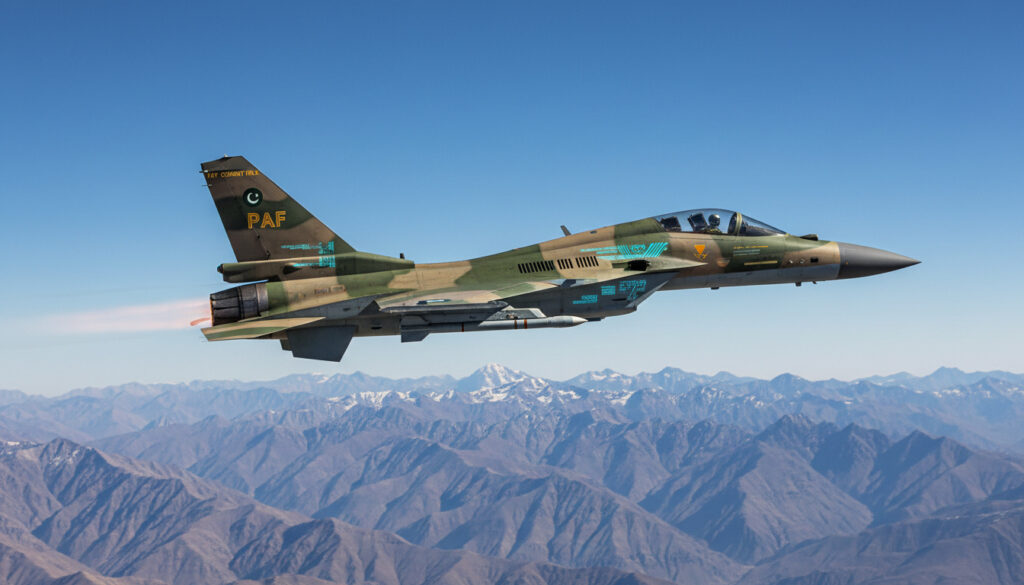
CAC/PAC JF-17 Thunder – Specs, Blocks and PAF Role
The CAC/PAC JF-17 Thunder stands as a lightweight, single-engine multirole fighter developed jointly by China’s Chengdu Aircraft Corporation (CAC) and Pakistan Aeronautical Complex (PAC). Designed as a cost-effective replacement for aging fleets including the A-5C, F-7P/PG, Mirage III, and Mirage 5, the aircraft integrates a diverterless supersonic intake (DSI) to reduce weight, manufacturing costs, and radar cross-section compared to traditional intake designs.
Also designated the FC-1 Xiaolong, the JF-17 program represents a strategic defense partnership between Beijing and Islamabad. The aircraft serves as the backbone of the Pakistan Air Force modernization efforts, with over 100 airframes currently operational across multiple variants ranging from the initial Block I to the advanced Block III configuration.
Positioned in the export market as an affordable alternative to Western fourth-generation fighters, the JF-17 carries a unit cost of approximately $15–25 million. This pricing structure targets air forces seeking beyond-visual-range combat capabilities and multirole flexibility without the procurement burdens associated with comparable Western or Russian systems.
What defines the CAC/PAC JF-17 Thunder’s core design and capabilities?
Joint development between Chengdu Aircraft Corporation (CAC) and Pakistan Aeronautical Complex (PAC), initiated following the cancellation of the Sabre II project in 1989.
Lightweight, single-engine multirole fighter optimized for air-to-air and air-to-ground missions with rapid deployment characteristics.
Active production with Block III variants incorporating 4.5-generation avionics and AESA radar systems currently entering service.
Maximum speed Mach 1.8 (Block III), 7–8 hardpoints, 3,600 kg payload capacity, unit cost $15–25 million.
Essential characteristics
- Cost-effective procurement at roughly half the price of comparable Western fighters, enabling fleet-wide modernization for budget-constrained air forces.
- Diverterless supersonic intake (DSI) design reduces radar cross-section and structural weight while improving stealth characteristics over conventional intake geometries.
- 4.5-generation capability in Block III configuration featuring Active Electronically Scanned Array (AESA) radar for multi-target tracking and beyond-visual-range combat.
- Operational backbone of the Pakistan Air Force with over 100 aircraft inducted across Block 1, Block 2, and Block III standards.
- Confirmed export success to Myanmar with active interest from Nigeria and Azerbaijan for fleet modernization programs.
- Dual-seat JF-17B variant operational since 2017, providing advanced training capabilities while maintaining full combat readiness.
- Standard weapon integration including PL-15E beyond-visual-range missiles with 145+ km range and precision air-to-surface munitions.
Technical specifications
| Attribute | Specification |
|---|---|
| First Flight | August 2003 |
| PAF Introduction | March 2007 |
| Unit Cost | $15–25 million |
| Engine (Block I/II) | Klimov RD-93 (80 kN thrust) |
| Engine (Block III) | Klimov RD-93MA (91.2 kN thrust) |
| Max Speed | Mach 1.6 (Block I/II); Mach 1.8 (Block III) |
| Combat Radius | 560–900 km (1,352 km max) |
| Service Ceiling | 16,794 m (55,500 ft) |
| Crew | 1 (JF-17A/C); 2 (JF-17B) |
| Length | 14.9 m (49 ft) |
| Wingspan | 9.44 m (31 ft) |
| Hardpoints | 7–8 |
How has the JF-17 Thunder evolved from initial blocks to the current Block III?
The JF-17 program has progressed through three distinct production blocks since series manufacturing commenced at Pakistan Aeronautical Complex Kamra in June 2009. Each iteration has introduced substantive avionics, propulsion, and armament improvements while maintaining the airframe’s fundamental lightweight architecture.
Block I and Block II foundations
Block I established the baseline operational capability with mechanical radar systems and the Klimov RD-93 engine generating 80 kN of thrust. Block II production commenced in 2018, incorporating aerial refueling probes, improved electronic warfare suites, and enhanced weapons integration. By December 2020, PAC had delivered 26 Block II airframes to the Pakistan Air Force.
Block III advanced capabilities
Block III represents the platform’s transition to 4.5-generation status. The variant integrates an Active Electronically Scanned Array (AESA) radar enabling simultaneous multi-target tracking and enhanced situational awareness. Propulsion upgrades include the RD-93MA engine producing 91.2 kN thrust, increasing maximum speed to Mach 1.8. Avionics modernization encompasses dual redundant mission computers, a 1553 Mux data bus, and a smart head-up display with 28-degree field of view.
The Block III’s AESA radar, cited by technical documentation, provides the JF-17 with beyond-visual-range engagement capabilities previously unavailable in earlier blocks. This system supports the carriage and targeting of the PL-15E missile, extending effective combat range to 145+ kilometers.
Which countries operate the JF-17 Thunder and what are its export prospects?
While the Pakistan Air Force remains the primary operator with over 100 aircraft in inventory, the JF-17 has achieved limited but significant international penetration. The aircraft’s value proposition centers on delivering multirole capability at acquisition costs substantially below Western equivalents.
Current operators
Myanmar operates the JF-17 as a confirmed export customer, deploying the aircraft for air defense and ground attack missions. The Myanmar Air Force’s adoption marked the type’s first operational service outside Pakistan, validating the platform’s suitability for Southeast Asian climatic and operational conditions.
Potential future acquisitions
Nigeria has explored JF-17 acquisition to modernize its fighter inventory, though specific contract details remain unconfirmed. Azerbaijan has evaluated the aircraft for potential procurement, with defense security reports indicating active assessment of Block III capabilities against regional requirements. Additional undisclosed nations have reportedly expressed interest, though no firm contracts have materialized beyond Myanmar.
Pakistan Aeronautical Complex maintains series production lines capable of satisfying both domestic PAF requirements and export orders simultaneously. The facility at Kamra has produced JF-17s continuously since 2009, with manufacturing rates scalable based on contract requirements.
How does the JF-17 Block III compare to the F-16 Fighting Falcon?
Comparative analysis between the JF-17 Block III and contemporary F-16 variants reveals competitive performance metrics despite significant cost differentials. The following table delineates key operational parameters:
| Feature | JF-17 Block III | F-16 (Reference Variant) |
|---|---|---|
| Origin | Pakistan/China | United States |
| Generation | 4.5 | 4.5 |
| Engine Thrust | RD-93MA (91.2 kN) | F404-IN20 (84 kN) |
| Maximum Speed | Mach 1.8 | Mach 1.6–2.0 |
| Combat Radius | 900 km (1,741 km with tanks) | 800–1,000 km |
| Service Ceiling | 55,500 ft | 50,000 ft |
| Thrust-to-Weight Ratio | 1.07 | 0.98–1.02 |
| Unit Cost | $15–25 million | Significantly higher |
While the JF-17 Block III demonstrates superior thrust-to-weight ratio and service ceiling compared to baseline F-16 configurations, direct combat effectiveness depends on pilot training, integrated electronic warfare suites, and supporting command-and-control infrastructure rather than isolated performance metrics.
What is the development and production timeline of the JF-17 program?
- : Pakistan abandons the Sabre II project, creating requirement for new affordable fighter.
- : DSI development initiated; airframe design finalized by CAC and PAC engineers.
- : First prototype rolls out at Chengdu facilities.
- : Maiden flight completed successfully.
- : First production aircraft delivered to Pakistan Air Force.
- : Series production commences at PAC Kamra facility.
More related posts
 370 USD to CAD: How Much is 370 US Dollars in CAD
 Accident on 401 Today: Live Updates, Map and Latest News
 Vancouver Whitecaps FC vs Inter Miami Stats – Final Score Goals Lineups Insights
 Chiwetel Ejiofor: Biography, Movies, and Personal Life
 Members of Linkin Park – Current Lineup and 2024 Changes
 What Does Rick Mercer Do Now? Age, Partner, Net Worth, and More
 Jeff Probst: Age, Marriages, Health, and Survivor Salary