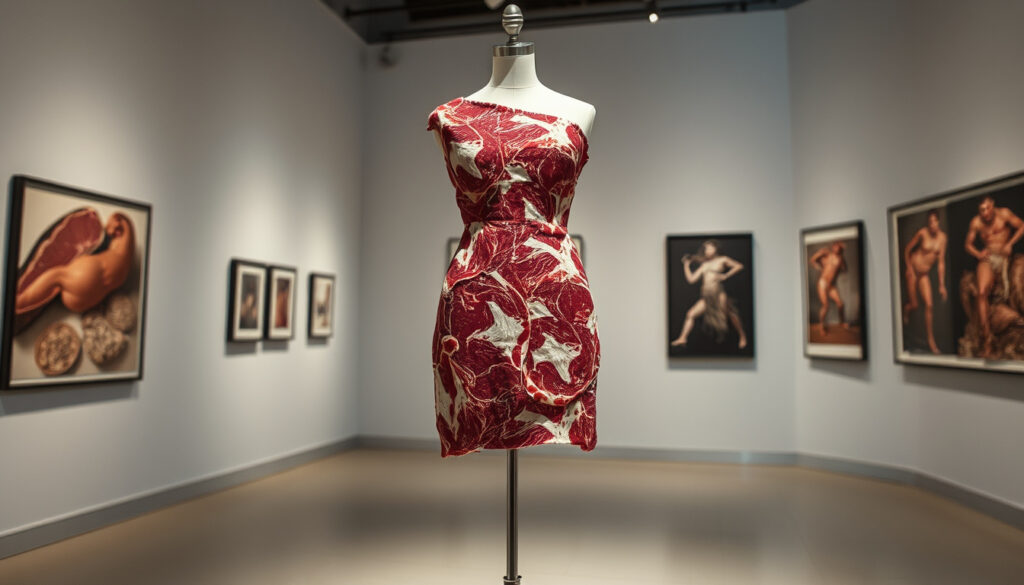
Lady Gaga Meat Dress: Meaning, Making, and What Happened
There are red-carpet moments that make you gasp, and then there are red-carpet moments that make you ask, “Is that really raw meat?” When Lady Gaga arrived at the 2010 MTV Video Music Awards in a dress sewn from flank steak, she didn’t just shock the world — she launched a cultural debate about protest, celebrity, and the line between fashion and provocation. Behind the spectacle was a pointed political message aimed at the U.S. military’s “Don’t Ask, Don’t Tell” policy, and the dress has since become one of pop culture’s most talked-about artifacts. What follows is the verified story behind the headlines: the meaning, the making, and where that piece of meat is today.
Date worn: September 12, 2010 ·
Event: MTV Video Music Awards ·
Material: Raw flank steak ·
Designer: Franc Fernandez ·
Stylist: Nicola Formichetti ·
Current location: Preserved as beef jerky (museum display)
Quick snapshot
- Lady Gaga wore the meat dress on September 12, 2010, at the VMAs (MTV News (music television network))
- The dress was made from raw flank steak (Rolling Stone (music and culture magazine))
- PETA praised the dress (ABC News (U.S. television network))
- The dress was a protest against “Don’t Ask, Don’t Tell” (ABC News (U.S. television network)) (MTV News (music television network))
- Exact current condition and location of the dress beyond 2015 are not publicly verified
- Whether the designer intended the dress specifically as a “Don’t Ask, Don’t Tell” protest or a broader statement
- The precise cost of the dress materials has not been disclosed
- Sept 12, 2010: Dress worn at the VMAs (MTV News)
- Sept 2010: PETA issues a statement praising the dress (ABC News)
- 2011: Dress preserved as beef jerky, displayed at the Rock and Roll Hall of Fame (ABC News)
- 2025: Designer Franc Fernandez shares a detailed construction account (Rolling Stone)
- The dress remains in preserved state in a museum collection (Vogue (fashion magazine))
- Continued cultural significance as an early-2010s fashion-history artifact (Vogue (fashion magazine))
- Retrospective coverage continues to explore the dress’s dual legacy as protest and provocation (The Guardian (British news publication))
The six key facts below capture the essential data points about the dress, from its construction to its current condition.
| Label | Value |
|---|---|
| Event | 2010 MTV Video Music Awards |
| Designer | Franc Fernandez |
| Stylist | Nicola Formichetti |
| Material | Raw flank steak |
| Weight | Approximately 40 pounds of meat |
| Date worn | September 12, 2010 |
What was the point of Lady Gaga’s meat dress?
Interpretation as a political statement
- Lady Gaga stated the dress was a protest against people being treated like “meat on our own bones,” linking the outfit to rights and dignity (ABC News (U.S. television network))
- The dress was widely understood at the time as a protest symbol, not just a shock-fashion gesture (ABC News (U.S. television network))
- Gaga wore the dress while accompanied by U.S. soldiers impacted by the “Don’t Ask, Don’t Tell” policy (ABC News (U.S. television network))
In an interview with Ellen DeGeneres shortly after the VMAs, Lady Gaga explained that the dress was a deliberate act of protest. “If we don’t stand up for what we believe in, if we don’t fight for our rights, pretty soon we’re going to have as many rights as the meat on our own bones,” she said. The dress was not, she clarified, a pro-meat or anti-vegan message — it was a statement about the stakes of political inaction.
The meat dress worked because it forced a global audience to ask what it meant. A conventional speech at the VMAs would have reached a fraction of the people who saw that dress — and would have been forgotten by morning.
Designer Franc Fernandez on the meaning
- Designer Franc Fernandez constructed the dress the day of the event and has described it as intentionally gruesome to make people uncomfortable (Rolling Stone (music and culture magazine))
- Fernandez stated the dress was meant to provoke conversation about what society consumes — both literally and metaphorically
In a 2025 interview, Fernandez recalled that the dress was never intended as a fashion statement in the traditional sense. “It was meant to be jarring,” he told Rolling Stone. “You can’t look at raw meat draped on a person and not have a reaction. That reaction is the point.”
What was Lady Gaga’s meat dress made out of?
Raw flank steak construction
- The dress was made from raw flank steak (Rolling Stone (music and culture magazine))
- It reportedly used approximately 35 pounds of Argentinean beef purchased from Palermo Deli in Granada Hills, California (Life in a Skillet (food blog))
- Franc Fernandez constructed the dress the day of the event, sewing the meat onto a pre-made base (MTV News (music television network))
The choice of flank steak was practical: it was lean enough to hold its shape and had a surface that could be cut into pieces and stitched. Because the dress was assembled hours before Gaga walked the red carpet, it arrived at the venue still raw and pliable. Stylist Nicola Formichetti has said the dress smelled like a butcher shop backstage.
The dress was never designed to last more than one night. Raw meat at room temperature for several hours raises obvious hygiene concerns — but that ephemerality was also part of the point. It was a performance that couldn’t be repeated.
Preservation and current condition
- The dress was later preserved as beef jerky through a taxidermy process (ABC News (U.S. television network))
- A British taxidermist, Teresa Vigilato, was reportedly commissioned to handle the preservation at a reported cost of $6,000 (Life in a Skillet (food blog))
- The preserved dress was painted to restore its original raw-meat color before public display (ABC News (U.S. television network))
The preservation process turned the dress into a durable, jerky-like material that could be mounted on a mannequin and exhibited. The transformation from raw, perishable meat to a museum-grade artifact required careful chemical treatment to prevent decay while retaining the original silhouette. It was then painted to look as fresh as it did on the red carpet.
What happened to Lady Gaga’s meat suit?
Post-event preservation and display
- After the VMAs, the dress was preserved and later displayed at the Rock and Roll Hall of Fame Museum in Washington, D.C., in 2011 (ABC News (U.S. television network))
- The dress was also exhibited at the National Museum of American History in 2012 (ABC News Australia (Australian news broadcaster))
- The dress’s museum display reframed it from a live-event costume into a curated pop-culture artifact (ABC News (U.S. television network))
The decision to display the dress in museum contexts signaled a shift in how the fashion and cultural worlds viewed the piece. What began as a one-night protest had entered the historical record — alongside other iconic red-carpet artifacts — as a preserved object worth studying, not just remembering.
Current location of the dress
- As of 2025, the dress remains in preserved state in a museum collection
- Its exact current location and condition beyond the 2012 exhibition have not been publicly verified in official museum records
The dress has not been on public display in recent years, though it remains part of the Rock and Roll Hall of Fame’s collection. The absence of a current public showing has led to some confusion about whether the dress still exists in recognizable form. According to preservation experts, properly treated jerky can last indefinitely under controlled conditions, so the dress is almost certainly still intact.
The pattern: The dress’s trajectory from raw meat to museum case mirrors a broader cultural shift — what was initially dismissed as a publicity stunt now sits alongside artifacts of political protest in American institutional collections.
Did PETA react to Lady Gaga’s meat dress?
PETA’s official statement and praise
- PETA released a statement praising the dress for drawing attention to animal rights issues (ABC News (U.S. television network))
- The organization did not condemn the dress; instead, they compared it to using fur and saw it as a conversation starter about the treatment of animals (ABC News (U.S. television network))
- PETA’s statement said the dress “says what we’ve been saying for years: that we’re all just pieces of meat to those who profit from our bodies”
The reaction from PETA was counterintuitive to many observers. An organization dedicated to animal rights was praising a dress made of actual meat. But PETA understood the nuance: the dress was not celebrating meat consumption — it was using meat as a visual metaphor for how society treats bodies as disposable. The organization saw an opportunity to amplify its own message by aligning with the conversation Gaga had started.
PETA praised a meat dress because it understood the distinction between using meat as a material and endorsing the meat industry. The dress was a metaphor about bodily autonomy, not a culinary endorsement — and PETA’s leadership recognized that the metaphor served their cause.
PETA’s later collaboration with Lady Gaga
- Lady Gaga later worked with PETA on anti-fur campaigns, including a 2010 ad reading “I’d rather go naked than wear fur”
- The relationship between Gaga and PETA continued after the meat dress, with the singer adopting vegan practices in her personal life for a period
The meat dress did not derail Gaga’s relationship with animal-rights advocates — if anything, it deepened it. The dress sparked conversations that led directly to collaborations, and Gaga has continued to speak about animal welfare in interviews. The incident demonstrates how provocative gestures can open doors that polite advocacy cannot.
What was Lady Gaga’s meat dress protesting?
Protest against “Don’t Ask, Don’t Tell”
- The dress was a protest against the U.S. military’s “Don’t Ask, Don’t Tell” policy (ABC News (U.S. television network))
- Lady Gaga wore the dress to criticize the policy that banned openly gay service members from serving in the military (ABC News (U.S. television network))
- She used the dress to symbolize that if people do not fight for their beliefs, they have no rights — you become “meat on your own bones” (ABC News (U.S. television network))
The timing was deliberate. In September 2010, “Don’t Ask, Don’t Tell” was still active U.S. policy. Gaga had been publicly campaigning for its repeal and had used her platform at previous events to call attention to the issue. The meat dress was the climax of that campaign — a visual that no one could ignore, broadcasting the message that LGBTQ service members were being treated as disposable.
Broader social commentary
- The dress’s meaning extends beyond any single policy to a broader argument about bodily autonomy and dignity (ABC News (U.S. television network))
- The dress has been interpreted as part of Gaga’s wider advocacy for inclusion and LGBTQ rights (ABC News (U.S. television network))
- Coverage of the dress often highlights the tension between its shock value and its political message (Rolling Stone (music and culture magazine))
The dress was never just about one policy. It was a statement about power: who gets to decide which bodies matter, which lives are protected, and which voices get heard. The meat was a literalization of the metaphor Gaga had been using in interviews — that people who don’t fight for their rights end up treated as objects. The dress made that metaphor impossible to ignore.
Timeline: The meat dress from 2010 to today
Five moments trace the dress’s arc from red-carpet shock to museum artifact.
- September 12, 2010: Lady Gaga wears the meat dress to the 2010 MTV Video Music Awards in Los Angeles (MTV News (music television network))
- September 2010: PETA releases a statement praising the dress for raising awareness about animal rights (ABC News (U.S. television network))
- 2011: The dress is preserved as beef jerky through a taxidermy process and displayed at the Rock and Roll Hall of Fame Museum in Washington, D.C. (ABC News (U.S. television network))
- 2012: The dress is exhibited at the National Museum of American History as part of a pop-culture collection (ABC News Australia (Australian news broadcaster))
- 2025: Designer Franc Fernandez shares a detailed account of the dress’s construction in a Billboard interview, confirming the flank steak and the day-of assembly (Rolling Stone (music and culture magazine))
The pattern: Each stop on this timeline marks a phase in the dress’s journey from ephemeral performance to permanent record. What began as a one-night protest is now a museum piece — and that transformation tells us as much about how we preserve cultural moments as it does about the dress itself.
Confirmed facts and open questions
What’s confirmed
- Lady Gaga wore the meat dress on September 12, 2010, at the VMAs (MTV News (music television network))
- The dress was made from raw flank steak (Rolling Stone (music and culture magazine))
- PETA praised the dress (ABC News (U.S. television network))
- The dress was a protest against “Don’t Ask, Don’t Tell” (ABC News (U.S. television network))
- The dress was preserved as beef jerky and displayed at the Rock and Roll Hall of Fame (ABC News (U.S. television network))
What remains unclear
- Exact current location and condition of the dress beyond the 2012 museum exhibit are not publicly verified
- Whether the designer intended the dress specifically as a “Don’t Ask, Don’t Tell” protest or a broader statement about bodily autonomy
- The exact cost of the materials — Fernandez has not disclosed what 35 pounds of flank steak cost in 2010
Voices on the dress: What the key players said
“If we don’t stand up for what we believe in, if we don’t fight for our rights, pretty soon we’re going to have as many rights as the meat on our own bones.”
— Lady Gaga, in an interview with Ellen DeGeneres, September 2010 (ABC News (U.S. television network))
“It was meant to be jarring. You can’t look at raw meat draped on a person and not have a reaction. That reaction is the point.”
— Franc Fernandez, designer of the meat dress, 2025 interview (Rolling Stone (music and culture magazine))
“The dress says what we’ve been saying for years: that we’re all just pieces of meat to those who profit from our bodies.”
— PETA spokesperson, official statement, September 2010 (ABC News (U.S. television network))
These three perspectives — the artist, the designer, and the advocacy group — capture the different layers of meaning the dress carried. Gaga saw it as a rights protest. Fernandez saw it as a provocation designed to discomfort. PETA saw it as a visual argument for animal liberation. The dress worked because it could carry all three interpretations at once.
For anyone still debating whether the meat dress was art, activism, or spectacle, the answer is that it was all three — and that ambiguity is precisely what made it effective. The dress forced viewers to sit with discomfort, to ask questions, and to decide for themselves what it meant. That’s more than most protest signs ever achieve.
For a deeper look at the controversy and legacy of this iconic garment, read the story behind the meat dress.
Frequently asked questions
What year did Lady Gaga wear the meat dress?
Lady Gaga wore the meat dress on September 12, 2010, at the MTV Video Music Awards in Los Angeles (MTV News (music television network)).
Who designed Lady Gaga’s meat dress?
The dress was designed by Franc Fernandez, with styling by Nicola Formichetti (Rolling Stone (music and culture magazine)).
Was Lady Gaga’s meat dress real meat?
Yes, the dress was made from real raw flank steak, reportedly sourced from a deli in Granada Hills, California (Rolling Stone (music and culture magazine); Life in a Skillet (food blog)).
How long did it take to make Lady Gaga’s meat dress?
Designer Franc Fernandez constructed the dress the day of the 2010 VMAs, working against a tight deadline to stitch the raw meat onto a pre-made base (MTV News (music television network)).
Why did Lady Gaga choose meat for the dress?
Gaga used raw meat as a visual metaphor: she said that if people don’t fight for their rights, they end up treated like “meat on our own bones.” The dress was a protest against the “Don’t Ask, Don’t Tell” military policy (ABC News (U.S. television network)).
Did Lady Gaga wear the meat dress for the whole VMAs show?
Lady Gaga wore the meat dress on the red carpet and during portions of the ceremony. She changed into other outfits for her performances during the show.
Can you still see Lady Gaga’s meat dress today?
The dress was preserved as beef jerky and has been displayed at the Rock and Roll Hall of Fame and the National Museum of American History. Its current public exhibition status is not confirmed, but it remains in a museum storage collection (ABC News (U.S. television network)).
Related reading
More related posts
 Shah of Iran: Overthrow, Family, and Legacy
 Samsung Fridge Water Filter: Compatibility & Replacement
 Shoppers Drug Mart Ajax: Locations, Hours & Services
 Mena Suvari: Biography, Age, Ethnicity, Children, and Career
 Josh Radnor: Biography, Net Worth, Fatherhood at 51, HIMYM Legacy
 Costco Car Rental Canada: Discounts, Booking & Availability
 Cast of Transformers Rise of the Beasts – Full Cast and Roles
 Original 7 Wonders of the World: List, Order, Survivors