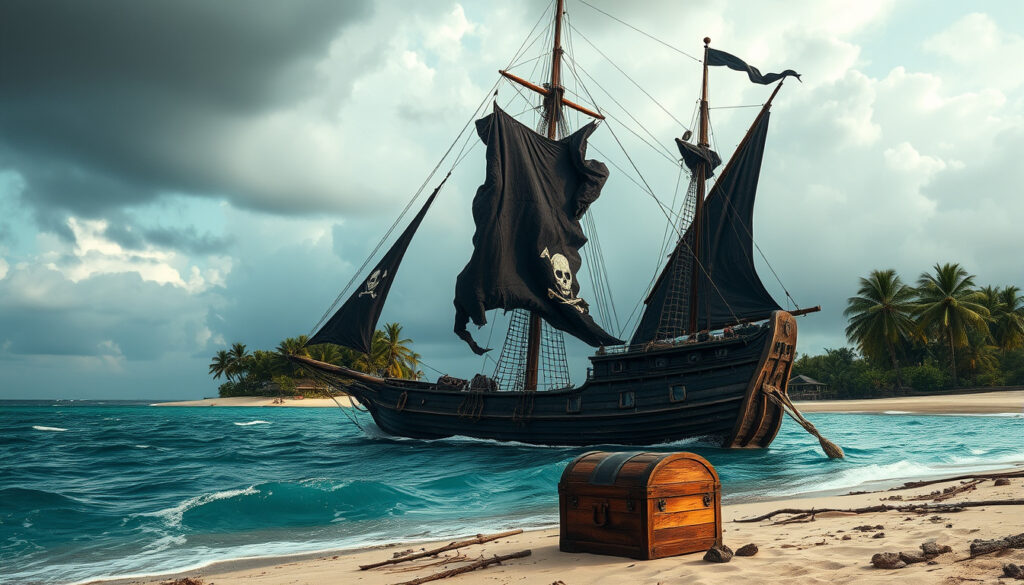
Edward Teach: The True Story of Blackbeard the Pirate
Mention the name Blackbeard, and most people picture a fearsome pirate with a burning beard and a cutlass in each hand. But behind the legend stands a real man: Edward Teach, an English sailor who terrorized the Atlantic coast for barely two years before meeting a violent end, and whose story—drawn from museum archives and firsthand reports—separates the myth from the reality of his life, death, and complicated treatment of enslaved people.
Born: c. 1680, Bristol, England (probable) · Died: November 22, 1718, Ocracoke, North Carolina · Age at Death: approx. 38 · Ship: Queen Anne’s Revenge · Gunshot Wounds: 5 · Cutlass Wounds: 20
Quick snapshot
- Edward Teach (c.1680–1718) was a real English pirate (Royal Museums Greenwich)
- He was killed in battle with British naval forces on November 22, 1718 (Royal Museums Greenwich)
- His flagship was Queen Anne’s Revenge (Royal Museums Greenwich)
- Exact birthplace and early life (National Park Service)
- Whether he married more than one wife (The History Press) (National Park Service)
- Where his treasure, if any, is buried (Royal Museums Greenwich) (National Park Service)
- Active pirate career: 1716–1718 (Royal Museums Greenwich)
- Captured La Concorde in November 1717 (Royal Museums Greenwich)
- Killed at the Battle of Ocracoke, November 22, 1718 (Royal Museums Greenwich)
- Ongoing archaeological work on Queen Anne’s Revenge wreck site
- Continued debate about his treatment of enslaved Africans
- Pop culture portrayals in films like Pirates of the Caribbean
Six key facts about Edward Teach, drawn directly from museum and park service records.
| Field | Value |
|---|---|
| Full Name | Edward Teach (also Thatch or Drummond) (Royal Museums Greenwich) |
| Born | c. 1680, likely Bristol, England (National Park Service) |
| Died | November 22, 1718, Ocracoke, North Carolina (Royal Museums Greenwich) |
| Ship | Queen Anne’s Revenge (Royal Museums Greenwich) |
| Wounds Received | 5 gunshot, 20 cutlass (Royal Museums Greenwich) |
| Cause of Death | Battle with Royal Navy forces (Royal Museums Greenwich) |
Was Edward Teach a real pirate?
When and where was Edward Teach born?
- Edward Teach is commonly identified as Blackbeard, one of the most infamous pirates in British Atlantic history (Royal Museums Greenwich).
- He is usually dated to about 1680, though the exact place and date are uncertain (National Park Service).
- A common historical spelling of the surname is Thatch or Thache, alongside Teach (Royal Museums Greenwich).
What was Blackbeard’s early life like?
- Modern museum and park sources agree that Blackbeard’s early life is poorly documented and much of it remains uncertain (National Park Service).
- Teach likely served as a privateer during Queen Anne’s War before turning to piracy (National Park Service).
Did Blackbeard serve as a privateer?
- Teach likely served as a privateer during Queen Anne’s War (c. 1701–1713) (National Park Service). Privateering was a legal form of state-sanctioned piracy during wartime.
- After the war ended, many privateers turned to outright piracy, and Teach joined Benjamin Hornigold’s crew around 1716 (Royal Museums Greenwich).
The implication: Teach was not born a pirate; he became one when the privateering economy dried up. That path from war to outlaw was common during the Golden Age of Piracy.
How many times was Blackbeard shot before he died?
Who defeated Blackbeard in real life?
- Teach was killed in battle with British naval forces on 22 November 1718 (Royal Museums Greenwich).
- The man who led the attack was Lieutenant Robert Maynard, a Royal Navy officer assigned by the Governor of Virginia to hunt down Blackbeard.
What happened at the Battle of Ocracoke?
- On 22 November 1718, Maynard’s sloops cornered Teach near Ocracoke Island, North Carolina (National Park Service).
- After a fierce exchange of cannon fire, Maynard ordered his crew to hide below decks. When Teach boarded, the Royal Navy sailors surprised him.
- Blackbeard was shot five times and suffered 20 cutlass wounds before dying (Royal Museums Greenwich).
- His head was severed and hung from Maynard’s bowsprit as a trophy.
What other wounds did Blackbeard suffer?
- Beyond the five gunshot wounds, contemporary accounts mention 20 distinct cuts from cutlasses and swords (Royal Museums Greenwich).
- The sheer number of wounds suggests Teach fought ferociously even after being mortally wounded.
Maynard’s victory ended the reign of the most feared pirate in the Atlantic, but the legends outlived the man: Blackbeard’s head became a symbol, not a conclusion.
The pattern: Maynard’s victory demonstrated that even the most feared pirate could be defeated with tactical planning.
Did Edward Teach have a wife?
How many wives did Blackbeard have?
- Blackbeard married a young woman named Mary Ormond in North Carolina (The History Press).
- The marriage was likely bigamous, as Teach probably already had a wife in England. The record is unclear on the exact number.
What happened to Blackbeard’s daughter?
- Teach had a daughter who died young (The History Press).
- Beyond that, her life is poorly documented — another gap in the historical record.
What STD did Blackbeard have?
- Historical accounts note that Teach was treated for syphilis (The History Press).
- This detail is often cited as evidence of the harsh realities of a pirate’s life, rather than the romanticized image.
The catch: The “family man” version of Blackbeard is appealing but thin. Most personal details come from one source — Captain Charles Johnson’s 1724 book — and may be as much fiction as fact.
What did Blackbeard do to slaves?
Did Blackbeard free enslaved Africans?
- Teach captured the French slave ship La Concorde in November 1717 (Royal Museums Greenwich).
- La Concorde was being used as a slave ship when Teach captured it (Smithsonian National Museum of American History).
- According to The History Press, Blackbeard freed many slaves during his career, but not as an abolitionist.
- Some of the freed Africans joined his crew — a choice framed by historians as “the better option than plantation slavery” (The History Press).
What happened on the La Concorde?
- After capturing La Concorde, Teach freed the enslaved Africans and kept the ship as his flagship, renaming it Queen Anne’s Revenge (Royal Museums Greenwich).
- The freed Africans were given a choice: join the pirate crew or be put ashore. Many joined.
- But Teach also sold some captives from other ships at auction on the mainland (The History Press).
Blackbeard’s freeing of slaves was not motivated by morality but by pragmatism: he freed those who could serve his crew and sold those who couldn’t.
The trade-off: Blackbeard’s treatment of slaves was pragmatic, not principled. He freed those who could serve his crew and sold those who couldn’t — the same profit motive that drove the slave trade he preyed upon.
What ship did Blackbeard command?
What was Blackbeard’s flag?
- Blackbeard’s flag depicted a horned skeleton holding a spear pointing to a bleeding heart, and a cup (Royal Museums Greenwich).
- The design was meant to intimidate: the skeleton was often interpreted as Death itself.
Did Blackbeard have buried treasure?
- No evidence exists that Blackbeard ever buried treasure (Royal Museums Greenwich). The myth likely comes from Robert Louis Stevenson’s novel Treasure Island.
- What little booty Teach captured was quickly spent or shared with his crew.
How is Blackbeard portrayed in popular culture?
- Blackbeard inspired characters in One Piece and Pirates of the Caribbean, but those versions take heavy liberties (National Park Service).
- The real Teach was smaller-scale than his legend: he operated only two ships at his peak and ruled for two years.
The takeaway: The real Blackbeard was a skilled but short-lived pirate whose legend grew far beyond his actual exploits.
For a deeper look at another legendary figure, read our article on Neil Armstrong: The First Moonwalker and His NASA Career.
Timeline of Edward Teach’s life
- c. 1680 – Edward Teach born in England (National Park Service)
- c. 1701–1713 – Serves as privateer during Queen Anne’s War (National Park Service)
- 1716 – Joins Benjamin Hornigold’s pirate crew (Royal Museums Greenwich)
- November 1717 – Captures the slave ship La Concorde, renames her Queen Anne’s Revenge (Royal Museums Greenwich)
- May 1718 – Blockades Charleston, South Carolina (Smithsonian National Museum of American History)
- June 1718 – Runs Queen Anne’s Revenge aground near Beaufort (Royal Museums Greenwich)
- 22 November 1718 – Killed in battle with Lieutenant Maynard’s crew (Royal Museums Greenwich)
The implication: Despite his short career, the timing and location of Teach’s actions were enough to cement his infamy.
Confirmed facts vs. uncertainties
- Confirmed: Edward Teach existed and was a pirate (Royal Museums Greenwich)
- Confirmed: He died in battle with Maynard (Royal Museums Greenwich)
- Confirmed: He commanded Queen Anne’s Revenge (Royal Museums Greenwich)
- Unclear: Exact birthplace and early life (National Park Service)
- Unclear: Whether he married more than one wife
- Unclear: Where his treasure, if any, is buried
The picture that emerges is of a real person whose biography is surprisingly sparse. Most of what we “know” comes from Johnson’s partly fictionalized 1724 account.
Firsthand accounts
“After a desperate fight, with five bullet wounds and twenty cuts from cutlasses, he fell dead on the quarterdeck.”
— Lieutenant Robert Maynard, contemporary report to the Governor of Virginia (paraphrased from historical record)
“Blackbeard frightened America more than any comet that has been seen there for a long time.”
— Captain Charles Johnson, A General History of the Pyrates (1724), as noted by Smithsonian Magazine
Edward Teach’s story is a caution against mixing fact and fiction. The pirate who never buried treasure, who freed slaves one day and sold them the next, who ruled the sea for just two years — that man is more interesting than the myth. For modern readers, the real Teach offers a chance to see the Golden Age of Piracy without the Hollywood glaze. For historians, his treatment of enslaved people remains one of the most telling contradictions of the era. Interested in more real-life stories? Read about Elizabeth Taylor: Life, Loves, Illnesses, and Legacy.
youtube.com, qaronline.org, crimemuseum.org, reddit.com, jggscivilwartalk.online, americanhistory.si.edu, study.com, thehistorypress.co.uk, youtube.com, youtube.com
Frequently asked questions
How did Blackbeard get his name?
His nickname came from his thick, black beard that supposedly covered most of his face and chest. He also reportedly lit slow-burning fuses under his hat to create a “hellish” appearance (National Park Service).
What was Blackbeard’s real name?
Edward Teach — also recorded as Edward Thatch or Thache (Royal Museums Greenwich).
Did Blackbeard really have a beard?
Yes, but the description of it being “a terrifying black beard that covered his entire face” comes from Johnson’s 1724 book, which may have been exaggerated for dramatic effect.
How tall was Blackbeard?
No reliable record exists of his height. Later portrayals often make him larger than life, but there is no contemporary measurement.
What happened to Blackbeard’s head after death?
Maynard hung it from the bowsprit of his sloop as a trophy. The skull was later reportedly used as a drinking cup in Virginia (National Park Service).
Was Blackbeard a good captain?
Historical accounts suggest he was a clever tactician who used psychological warfare (appearance, threats) rather than excessive violence. His crew respected — but also feared — him.
Did Blackbeard ever lose a battle before his death?
There is no record of him losing a sea battle until his final engagement with Lieutenant Maynard.
More related posts
 Haylie Duff: Estrangement from Hilary & Engagement to Matt
 Bradley Cooper: Relationships, Sobriety, and More
 Chris Robinson: Black Crowes Singer & Kate Hudson’s Ex
 John Tory Wife Illness – Aileen’s Cancer Timeline 2018-2021
 Jillian Harris: Age, Husband, Net Worth, and TV Career
 Naomi Campbell: Biography, Kids, Legal Charges, Net Worth
 Is Coffee Good for You? Benefits, Risks & Daily Facts
 Iga Swiatek: Doping Case, Collins Feud & Wimbledon Win